
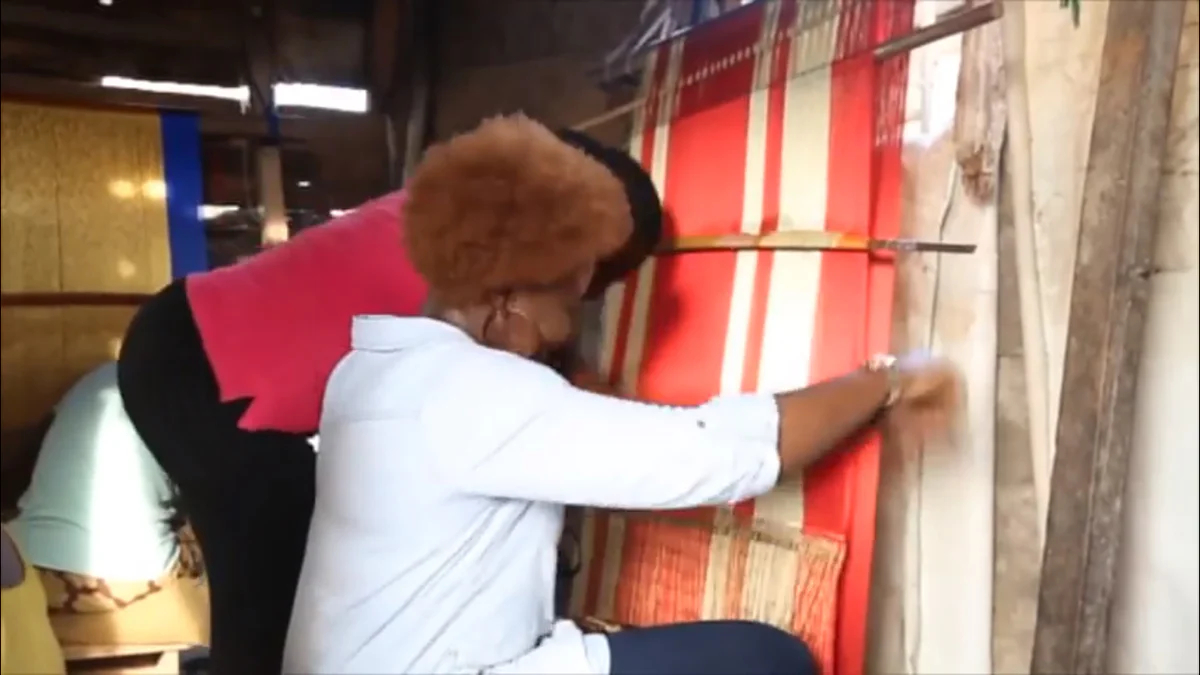


We were introduced to Karen Gold at London Ethnic’s London Fashion Week Reception in February, and immediately we were taken in by their use of rich colours and minimal, sharp, tailored trans-seasonal pieces. Karen Gold believes in and supports sustainable and ethical fashion. Karen recently took a trip to Nigeria to meet and explore the craft of the local artisans who work on the hand-loomed and embroidered Aso Oke fabric. Demur caught up with Karen Gold herself to discuss why this trip was essential for the brand.
Why is it important for you as a designer that your clothes are made ethically and are part of sustainable fashion? As a designer, I care about the impact of fashion on our environment and the need to use natural resources sustainably. I want to ensure that Karen Gold provides high-quality products and builds awareness to empower both our customers and producers to participate in fair trade and environmentally sustainable solutions.
Hand weaving is a traditional skill passed down through generations. Some of the local artisans we visited make a living through this method of fabric-making. Handlooms, which are powered by hand rather than electricity, produce about 8 to 12 metres of fabric per day. Fabric woven by hand uses nine times more labour than that which has been produced by a power loom. This provides more people with income and the ability to care for their families.
We work with producer groups to ensure weavers are paid fairly for their work. Each time a garment made with Fair Trade hand-woven fabric is purchased, we help families and communities forge a path out of poverty by ensuring that valuable, traditional livelihoods do not disappear. More importantly, hand-woven fabric protects the climate; hand looms do not require electricity and are carbon neutral. So it’s all environmentally friendly. Why did you choose to go all the way to Ibadan, Nigeria, to source material for your collection? I am originally from Nigeria and was aware of the craft, and when I was looking to make a difference in the industry, it felt natural to go to a place I was familiar with.
The people we work with have some of the smallest environmental footprints in the world. They live and work in communities without some of the basic essentials of modern life, which we often take for granted, like electricity, and it is through this craft that they earn a living. In the video, we see you taking part in the fabric-making. Did this help you appreciate the craft more? Absolutely, I certainly appreciate the craft more, especially now that I have seen the dedication and hard work that go into making hand-loomed fabrics.